
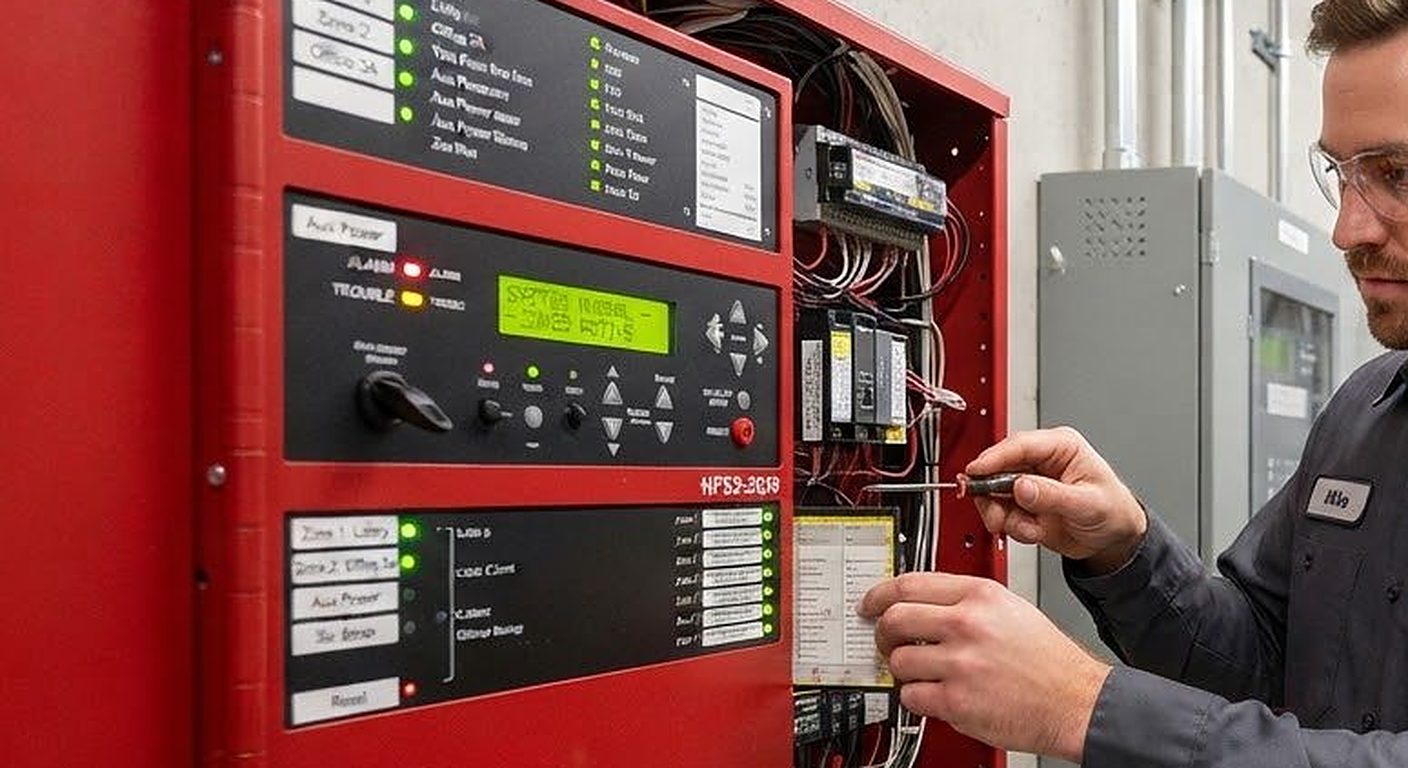
Every commercial fire alarm panel speaks a three-signal language: alarm (red — the system believes there's a fire), trouble (yellow — the system has detected a fault in itself), and supervisory (yellow — something the system monitors is in an abnormal state). Alarms get attention automatically. Trouble signals get silenced — and that's where buildings get into trouble of their own.
What a trouble signal actually means
A trouble condition means some part of your system can't be relied on right now. The panel is telling you which part — the display text matters. The common causes, roughly in order of frequency:
- Battery faults. Standby batteries age out every 3–5 years regardless of use; the panel flags them when they can no longer carry the required load. The most common trouble call and one of the cheapest fixes — batteries are commodity parts.
- Communication faults. The panel can't reach the central monitoring station: a failed communicator, a discontinued phone line, or an internet/cellular change nobody told the alarm company about. Common after telecom "upgrades" — the alarm dialer is the last thing anyone remembers is on that line.
- Circuit faults — opens and grounds. A break or ground fault on a device circuit. These have a suspicious habit of appearing right after other trades worked in the ceiling: a data cabler kneels on a conduit, an HVAC tech unplugs the wrong thing.
- Device faults. A dirty, aging, or failed detector reporting itself out of service. Dust-loaded detectors also drift toward nuisance alarms — which is what the two-year sensitivity testing in the NFPA 72 schedule exists to catch.
Trouble vs. supervisory: the sprinkler connection
Both show yellow, and the distinction matters. A supervisory signal usually points outside the alarm system — most commonly at a sprinkler control valve that's been closed and not reopened after maintenance, or a dry system's air pressure drifting, or a fire pump in an abnormal state. Treat supervisory signals seriously: a closed valve means part of your sprinkler coverage is off right now, and if it stays off you're heading toward fire watch territory. If the signal traces to sprinkler work, your sprinkler contractor belongs in the call alongside the alarm company.
Why silencing isn't fixing
The silence button acknowledges the signal; the fault remains. Two things then happen quietly:
- The system may not perform in a real fire — a dead battery bank means no alarm during a power outage, a failed communicator means no fire department dispatch at 3 a.m.
- The condition is timestamped in the panel's event log. Fire marshals review event histories during inspections, and insurers can obtain them after a loss. A trouble signal that sat silenced for six weeks reads very differently in claim forensics than one cleared in two days. It's also a standard citation in a failed fire inspection.
What to do when the panel beeps
- Read the display and record exactly what it says — photograph it. Modern addressable panels name the device or circuit; that text tells the technician what parts to bring.
- Check the simple causes: recent power outages (battery troubles follow them), recent construction or telecom work, anything unplugged in the panel room.
- Call your licensed fire alarm contractor with the display text in hand. Battery and device swaps are same-visit fixes; communicator replacements may need a monitoring coordination step.
- Tell your central station before any testing or repair, so signals generated during the work don't dispatch the fire department.
When trouble keeps coming back
A panel that troubles repeatedly is telling a bigger story — batteries aging out across the system at once, a communicator on a sunsetting cellular network, moisture in a conduit, or deferred annual testing accumulating faults. If your last full NFPA 72 test is more than a year old, start there rather than paying per-incident service calls; the math favors the annual test quickly. Find licensed alarm contractors near you — credentials shown on every profile.