
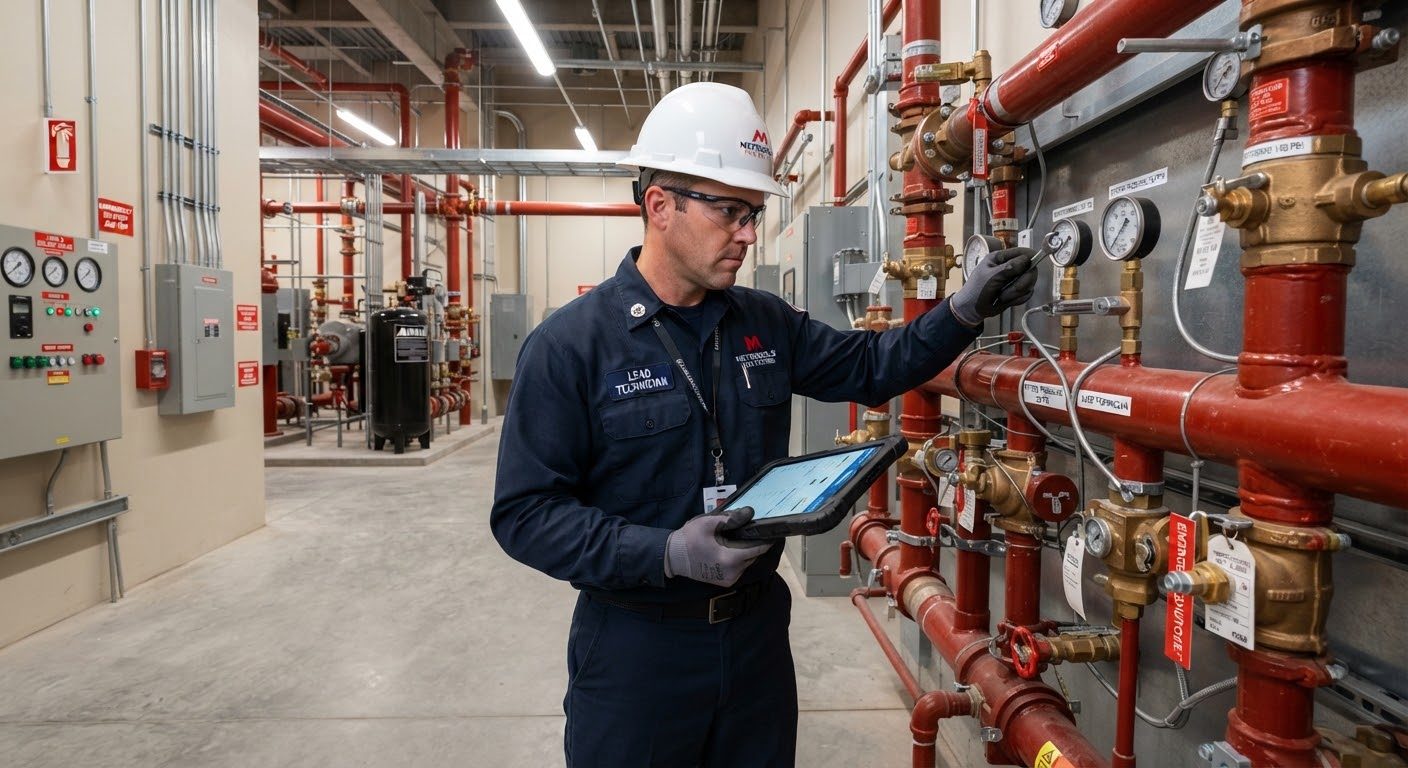
A fire pump exists for one moment: the day a fire demands more water pressure than your supply can deliver on its own. Because that moment may come once in the building's life, NFPA 25 gives fire pumps the most demanding test calendar of any fire protection component — short recurring tests to prove the pump starts and runs, and one annual test to prove it still delivers its rated flow.
If your building has a pump — most high-rises, large warehouses, and campuses do — this schedule belongs on your facility calendar next to the rest of the NFPA inspection schedule.
The fire pump test schedule
| Test | Frequency | Duration | Who performs it |
|---|---|---|---|
| Churn (no-flow) test — diesel pumps | Weekly | 30 minutes minimum | Trained staff or contractor |
| Churn (no-flow) test — electric pumps | Monthly (weekly in some settings/jurisdictions) | 10 minutes minimum | Trained staff or contractor |
| Annual flow test | Yearly | Half day typical | Licensed contractor |
| Controller, transfer switch & battery checks | With each churn test | — | Whoever runs the test |
Two notes on the schedule. First, the electric-pump interval moved from weekly to monthly in recent editions of NFPA 25 for most occupancies — but plenty of AHJs and insurance carriers still require weekly, so confirm which edition and amendments your jurisdiction enforces. Second, diesel pumps stay weekly everywhere: the test is as much about the engine, batteries and fuel system as the pump itself.
What a churn test actually involves
A churn test runs the pump against a closed system — no water flows, which is why it's also called a no-flow test. The operator starts the pump (automatically via pressure drop or manually), then watches and records: suction and discharge pressures, pump packing leakage, unusual noise or vibration, and for diesel drivers the oil pressure, engine temperature, and battery condition. The 30-minute diesel duration matters — it brings the engine fully up to operating temperature, which is exactly what a real fire would demand.
The most valuable habit is writing the numbers down every single time. A slow drift in churn pressure across three months of logs catches a failing pump long before the annual test does — and your fire marshal and insurer will both ask to see the log.
What the annual flow test proves
Once a year, a licensed contractor flows real water and measures whether the pump still meets its rated performance at three points: churn (no flow), 100% of rated capacity, and 150% of rated capacity. Water is discharged through hose monsters or measured with a calibrated flow meter, and the results are plotted against the pump's original factory curve.
This is the test that answers the only question that matters — will the sprinkler system get its design pressure in a fire? — because sprinkler system hydraulic designs assume the pump delivers its curve. A pump running 10% under curve quietly undermines every calculation the system was built on, which is why degraded results get treated as system impairments, not maintenance suggestions.
Costs and how to buy the test
Annual flow tests typically run roughly $500–$1,500 per pump, varying with pump size, site access, and test method; churn testing adds little or nothing if your own staff run it, or a modest monthly charge on a service contract. The efficient move for most buildings is bundling the pump flow test into the annual sprinkler inspection agreement — same contractor, same visit window, one report package for your AHJ and insurer.
Whoever you hire should be licensed for water-based fire protection work in your state and able to produce the pump curve plot, not just a pass/fail line on an invoice. Compare licensed fire protection companies near you — and if you're setting up your facility calendar, our free compliance calendar builder includes fire pump churn and flow test schedules.
The failures the tests are designed to catch
- Dead diesel batteries — the most common churn-test finding, and the classic cause of a pump that never starts.
- Closed or partially closed valves — silently defeats the entire system; caught by supervision and weekly walks.
- Packing and seal deterioration — shows up as excessive leakage during churn runs.
- Impeller wear and casing corrosion — invisible until the annual flow test plots the pump under its curve.
- Controller and transfer-switch faults — found only because each test exercises the automatic start sequence.